2026 RWA Fund Complete Guide: Yield Sources and Risk Analysis
BiFu Editorial · 2026-10-09 · 5 min read

Table of contents
By 2026, RWA funds tokenize real-world cash flows like Treasuries, private credit, real estate, and private equity, offering steady yield, fractional access, and faster settlement. But credit, liquidity, legal, and valuation risks remain.
Real-world asset (RWA) funds have evolved from early experiments into a practical allocation tool for investors looking to capture steady yield beyond crypto’s volatility. By late 2026, on-chain RWA value (excluding stablecoins) has reached the $38–51 billion range across major trackers, led by private credit and U.S. Treasuries. Tokenization has made high-minimum, traditionally illiquid assets fractionally accessible, with faster settlement and secondary-market trading options that were once unavailable.
What RWA Funds Actually Are in 2026
An RWA fund tokenizes a claim on real-world cash flows or assets, government securities, private loans, real estate income, commodities, or private-market equity, and records ownership on-chain. The token itself is not the yield engine. The underlying asset or portfolio generates the return; the blockchain mainly improves transparency, settlement speed, fractional ownership, and (when secondary trading is enabled) exit flexibility.
On platforms designed for multi-asset use, investors can subscribe with stablecoins, hold the position in the same account used for crypto, forex, or commodities, and move capital without repeated onboarding. BiFu’s RWA module operates inside this unified account model: one verification process, one capital pool, and access to tokenized bonds, funds, private credit, commodities, and private-market equity products after project review.
Primary Yield Sources in 2026
Yield in RWA funds comes from traditional economic activity, not from crypto-native incentives. The main sources today are:
Interest from fixed-income instruments
Tokenized U.S. Treasuries and money-market funds remain the largest conservative category. Yield tracks short-term government rates (typically in the low-to-mid 3% range net of fees in recent data). The return is simply the coupon or discount income passed through after management and custody costs. These products prioritize capital preservation and liquidity over high return.Private credit interest
Private credit has grown into one of the largest non-Treasury segments. Yield comes from interest paid by corporate or specialized borrowers. Spreads over Treasuries commonly sit in the 1.5–4+ percentage point range depending on credit quality, structure, and duration, producing realized yields often in the mid-single digits for higher-quality pools. The premium compensates for credit risk, less frequent liquidity, and underwriting complexity.Rental or operating income (real estate and similar)
When the underlying is income-producing property or infrastructure, the yield derives from rents or contracted cash flows after expenses, vacancies, and management fees. These products tend to offer moderate yields with lower day-to-day price volatility than pure equity, but they carry property-specific and liquidity risks.Private-market equity and growth assets
Some RWA funds give access to pre-IPO or private equity positions that were previously reserved for institutions. Here the “yield” is not a steady coupon but potential capital appreciation upon liquidity events (IPO, secondary sale, or acquisition). Ticket sizes on tokenized versions can start far lower than traditional private-market minimums, often in the low tens of thousands of dollars via stablecoin subscription.Commodity-linked or structured returns
Tokenized commodities (especially gold) primarily deliver price exposure rather than cash yield. Structured notes or actively managed strategies may blend fixed income with other sources to target a defined risk-return profile.
Diversified multi-strategy RWA products that spread across credit, Treasuries, and other real assets have held yields in roughly the 5–7% band in parts of 2026, drawing the spread from real-economy borrowers rather than crypto leverage cycles.
Key Risks Investors Must Price
RWA funds remove some crypto-native risks (no funding-rate dependence, no pure protocol token incentives) but introduce others that are often understated:
Credit and borrower risk. Especially in private credit. Defaults, restructurings, or concentration in a few borrowers can reduce or eliminate distributions.
Liquidity and redemption risk. Secondary markets improve exit options, yet many funds still impose gates, notice periods, or NAV discounts in stress. “Always tradable” is rarely absolute.
Structural and legal title risk. The token must confer a clear, enforceable claim on the underlying asset or cash flows. Weak SPV design, custody arrangements, or jurisdiction mismatches can leave holders with paper rather than rights.
Counterparty and operational risk. Issuers, custodians, auditors, and service providers sit between the investor and the asset. Failures here have frozen capital in past cases.
Interest-rate and duration risk. Treasury and fixed-income products move with rate changes. Longer-duration holdings amplify this.
Regulatory and compliance risk. Rules continue to evolve. Products may face access restrictions by region or investor type.
Valuation and transparency gaps. On-chain records help, but the quality of off-chain reporting, independent audits, and real-time NAV still varies by product.
Historical data outside pure Treasuries shows that defaults, non-repayments, and liquidity events have occurred in credit and less-standardized products. Treating all RWA as “safe yield” is a common mistake.
How Platform Design Changes the Experience
Access and risk management improve when RWA sits inside a broader multi-asset environment rather than a standalone tokenization silo. Key practical advantages include:
Single-account allocation across crypto, forex, commodities, stock CFDs, prediction markets, and RWA without moving capital between platforms.
Stablecoin subscription and, where product terms allow, secondary-market transfers.
Project-level review, on-chain ownership records, and partnership with legal, audit, and custody providers.
Clear risk ratings, minimum investment amounts, and disclosure of underlying assets, term, and yield source before subscription.
On BiFu, the RWA section is designed around this flow: browse reviewed projects (funds, bonds, private credit, private-market equity), allocate with stablecoins, monitor positions, and manage capital alongside other markets under the same margin and compliance framework. Multi-jurisdictional licensing and client-fund segregation support the institutional-grade requirements many RWA structures demand.
Practical Allocation Checklist for 2026
Before committing capital:
Identify the exact yield source (Treasury coupon, private-loan interest, rental income, equity upside).
Map the legal claim the token actually provides.
Review liquidity terms, redemption gates, and secondary-market depth.
Check concentration (single borrower, single property, single issuer).
Confirm independent audits, custody arrangements, and regulatory posture.
Size the position relative to overall portfolio risk tolerance. RWA is still subject to credit and liquidity events.
Prefer platforms that keep RWA inside a unified account so capital remains flexible across market regimes.
Conclusion
RWA funds in 2026 deliver real economic yield with clearer on-chain records and lower entry barriers than traditional private markets. The highest-quality products sit at the conservative end (Treasuries and high-grade credit). Higher advertised yields usually price in higher credit, liquidity, or structural risk. Investors who separate the source of return from the marketing narrative, and who use platforms that combine transparency with multi-asset flexibility, are better positioned to use these instruments as a genuine portfolio component rather than a speculative add-on.
Read more from BiFu
By 2026, RWA funds tokenize real-world cash flows like Treasuries, private credit, real estate, and private equity, offering steady yield, fractional access, and faster settlement. But credit, liquidity, legal, and valuation risks remain.
Related articles
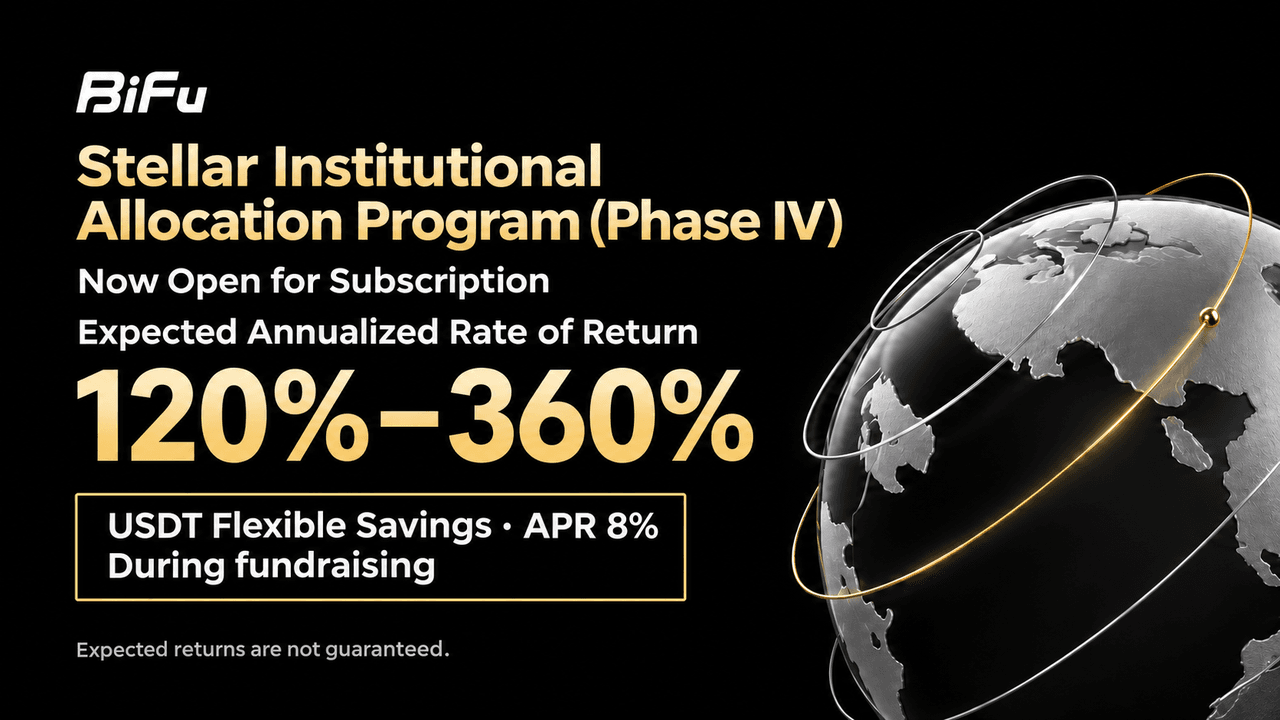
BiFu Launches the Stellar Institutional Allocation Program (Phase IV) | Expected Annualized Rate of Return of 120%–360%; Earn 8% APR with USDT Flexible Savings During the Fundraising Period
Phase IV of the Stellar Institutional Allocation Program opened on November 16 with a 100 USDT minimum, a 30-day term and an expected annualized rate of return of 120%–360%. Eligible funds can earn 8% APR through USDT Flexible Savings during fundraising, which closes on November 22.
2026-11-19 · 5 min read

High Liquidity Tokenized Products Recommendations
Explore BiFu's high-liquidity USDT Earn products, including flexible savings, short-term fixed deposits, and tokenized funds. Compare expected yields, redemption options, and risk levels to put idle stablecoins to work.
2026-11-10 · 6 min read


Trading
Risk Warning
Trading foreign exchange, contracts for difference, over-the-counter derivatives, margin products, and other leveraged financial instruments involves a high level of risk and may not be suitable for all clients. These products can result in losses that may exceed your initial deposit, depending on the product terms, account settings, and applicable legal protections. You should not trade unless you fully understand the nature of the products, the risks involved, and the extent of your exposure. When trading derivative products, you do not own or have any rights to the underlying asset.
The information provided on this website is general in nature and does not take into account your investment objectives, financial situation, trading experience, or particular needs. Nothing on this website should be construed as personal financial advice, investment advice, an offer, invitation, solicitation, recommendation, or inducement to buy, sell, subscribe for, or dispose of any financial product or service.
All market commentary, educational materials, research content, platform information, and other materials published on this website are provided for general information and reference purposes only. Past performance, historical data, examples, forecasts, or simulated results are not reliable indicators of future performance.
Access to Bifu Markets’ products and services is not available in all jurisdictions. We do not open accounts for residents of certain countries and jurisdictions, including but not limited to the United States, Australia, Canada, and the Democratic People's Republic of Korea.
By accessing this website, you confirm that you are doing so on your own initiative and that you are responsible for ensuring that your use of this website and any services provided by Bifu Markets complies with the laws and regulations applicable to you in your jurisdiction.
BiFu is operated by Bifu Markets (Pty) Ltd.
Registered address: Norwich Place West, 2nd Floor, Cnr 5th and Norwich, Sandown, Sandton, Gauteng, South Africa.