Beyond TradFi: A Trillion-Dollar Vision for Stock Tokenization
26/11/202503:41:21
Introduction
Imagine the following scenario: at 3 a.m. on a Sunday morning, while located somewhere in Southeast Asia or Africa, you decide to purchase a share of Apple stock using the only capital you have on hand—USD 10. Furthermore, within seconds of completing the purchase, you intend to use that equity position as collateral on-chain to borrow USDT and deploy it into another investment opportunity.
In the conventional financial system, such an idea would be regarded as virtually impossible. Wall Street remains encircled by rigid physical and institutional barriers: U.S. Equities, Hong Kong stocks, and A-shares operate in largely isolated markets, while cross-border capital flows must navigate the layered constraints of the SWIFT system. Limited trading windows of merely 6.5 hours a day, combined with a T+2 settlement cycle, significantly undermine capital efficiency. Additionally, high account-opening thresholds and whole-share trading requirements further exclude hundreds of millions of long-tail investors around the world from participation.
Stock tokenization seeks to offer an alternative to this restrictive paradigm. At its core, it involves representing traditional equities on the blockchain in tokenized form, and leveraging the blockchain’s attributes of 24/7 trading, global accessibility, and divisibility. These features enhance both the liquidity and composability of equities, enabling them to be widely integrated into various on-chain financial applications.
However, the path toward this vision is far from straightforward. Over the past several years, the market has attempted to strike a balance between decentralised technological architectures and existing regulatory frameworks, gradually giving rise to three distinct developmental pathways.
Three Pathways Toward Tokenized Equities
In the process of bringing equities onto the blockchain, three fundamentally different approaches have gradually taken shape. Each reflects a distinct response to the limitations of traditional financial infrastructure and the constraints of existing regulatory systems.
1.The CFD-Based Approach
In practice, what is often described as “stock tokenization” under this approach does not involve placing actual equity on-chain. Instead, it digitizes price exposure. Users are not acquiring a blockchain-based token that represents legal ownership of a share. Rather, they are entering into an over-the-counter derivative agreement whose value tracks the market price of the underlying stock.
Under this structure:
- Users cannot independently mint or redeem any on-chain representation of the asset;
- Positions cannot be freely transferred across wallets or protocols;
- The relationship between the user and the platform is contractual and price-based, rather than an ownership relationship between shareholder and issuing company.
Even when the platform holds the corresponding equities for hedging or risk management purposes, those securities are not registered in the user’s name. The user holds neither a private key nor any form of shareholder rights, including voting or corporate governance privileges. In effect, the “asset” exists only as a book entry within the platform’s internal accounting system.
Robinhood’s so-called “tokenized stock” offerings in parts of Europe serve as a representative example. While the interface mirrors the look and feel of a crypto-native product—featuring fractional access, extended trading windows, and lower entry thresholds—the underlying exposure is structured as a CFD linked to U.S. stock prices. Whether or not the platform chooses to purchase actual shares in U.S. markets is a matter of internal risk management; legally, any such shares remain on the platform’s balance sheet rather than in the possession of its users.
This approach undeniably expands access and simplifies cross-border participation in U.S. equity markets. At the same time, it sidesteps complex issues such as shareholder registration, voting-right transmission, and securities issuance compliance. However, it offers only a limited degree of decentralization and leaves users structurally dependent on the platform as the ultimate intermediary.
2.The Synthetic Asset Approach
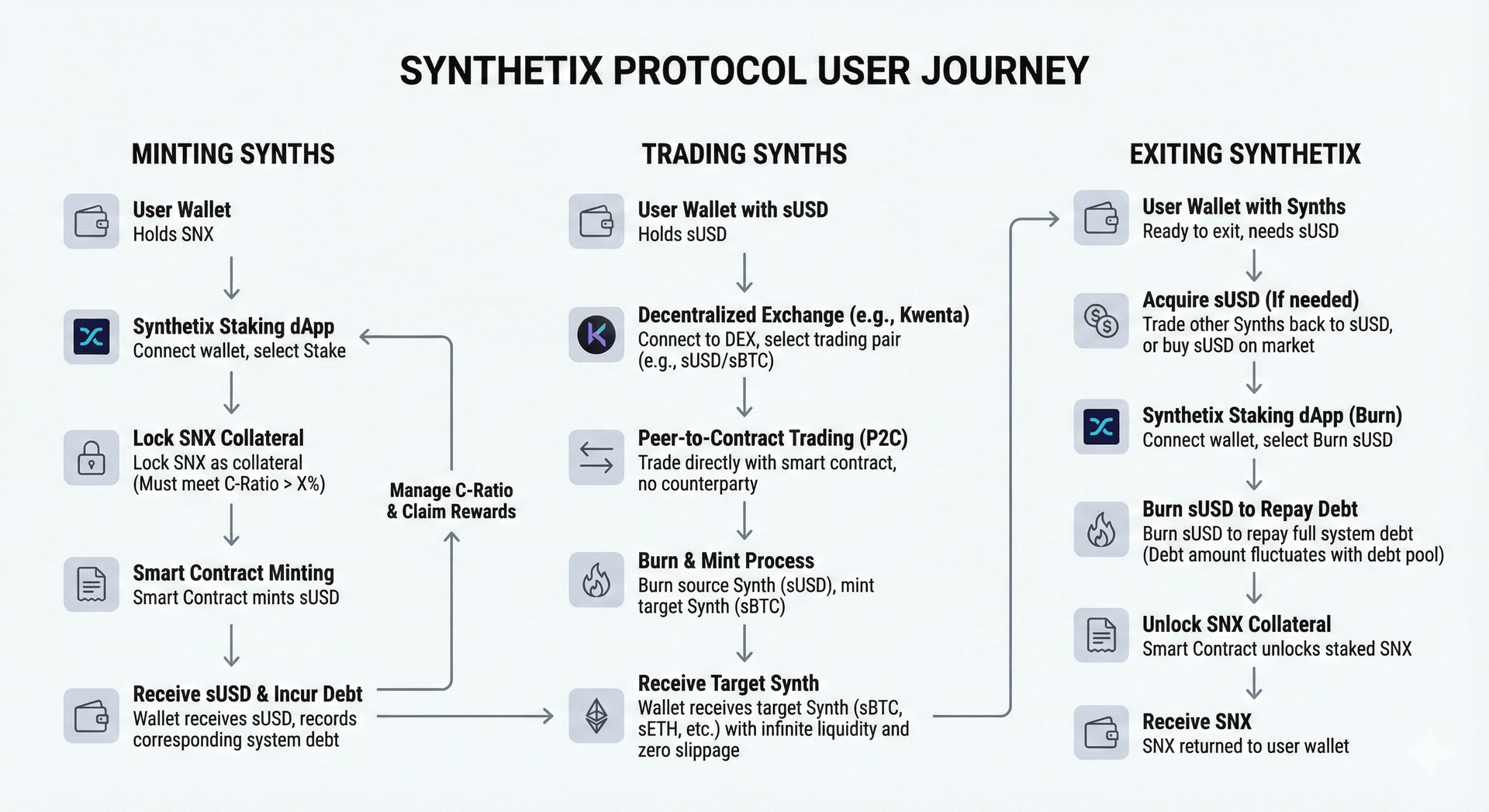
In contrast to the CFD-based structure embedded within traditional financial systems, protocols such as Synthetix and Injective introduce a fully decentralised mechanism for creating equity-like price exposure within the DeFi ecosystem. These systems operate independently of banks, brokers, or custodians, and do not require the holding of real-world assets such as stocks, bonds, or commodities.
Instead, participants interact directly with smart contracts deployed on public blockchains. Their counterparty is not a company or institution, but a collectively maintained collateral pool supported by all participants who have staked assets into the system.
Through the over-collateralisation of on-chain assets (such as ETH, stablecoins, or protocol-native tokens like SNX), and the continuous input of price data via decentralised oracles, users can mint synthetic instruments that mirror the price movements of equities, commodities, or other financial benchmarks. These synthetic assets do not correspond to, or confer claims on, any real-world security; they function solely as on-chain representations of price behaviour.
Compared with CFD-based exposure, this structure replaces traditional counterparty risk with protocol-level systemic risk. Although the architecture is designed to be permissionless, censorship-resistant, and free from reliance on trusted intermediaries, its stability is critically dependent on three interrelated factors:
(1) the integrity and resilience of oracle price feeds,
(2) the liquidity and volatility profile of the collateral base, and
(3) the effectiveness of the system’s liquidation and incentive mechanisms.
When collateral values fall sharply or oracle mechanisms fail, cascading liquidations may occur, potentially triggering a self-reinforcing collapse—commonly described as a “death spiral” dynamic.
As such, protocols like Synthetix and Mirror Protocol should be understood not as vehicles for the direct tokenization of real-world assets, but rather as decentralised financial engineering frameworks that construct synthetic price exposure. While they eliminate traditional intermediaries, they simultaneously introduce a distinct and novel risk architecture, fundamentally differentiating them from CFD-based structures.
3.The RWA / STO Approach
Projects such as Backed Finance and Dinari are exploring a route that is grounded in full collateralisation, regulated custody, and licensed issuance of real-world assets. At its core, this approach follows a relatively straightforward principle: Special Purpose Vehicles (SPVs) are established in jurisdictions such as Switzerland or the British Virgin Islands, through which a licensed issuer acquires and custodies real equities or other securities on a 1:1 basis. Corresponding tokens are then minted on-chain to represent either ownership interests or economic claims on these underlying assets.
Within this structure, on-chain tokens are neither synthetic constructs nor derivative contracts. Instead, they function more like legally recognised blockchain-native depositary receipts. Each token is explicitly backed by an identifiable real-world asset, with ownership or economic rights clearly defined through legal documentation and custody agreements. Conceptually, this arrangement bears similarities to traditional instruments such as ADRs or GDRs, but leverages blockchain technology as the foundational layer for registration, transfer, and verification, thereby introducing a higher degree of traceability and transparency.
In contrast to synthetic asset mechanisms, fully-backed RWA tokenization places far greater emphasis on the direct linkage between the on-chain representation and the real-world asset itself. Under this approach, underlying securities are held by an independent, regulated custodian, while their existence and status are anchored through a combination of on-chain disclosures and off-chain audits. This dual-layer verification enhances the traceability and verifiability of the relationship between token and asset. Moreover, the legal architecture is typically built around trust structures or beneficial ownership arrangements, allowing these tokens to align more closely with conventional notions of property rights and to be interpreted within existing legal and regulatory systems.
Nonetheless, this pathway is not without its constraints. To comply with KYC and AML requirements, token issuance and ownership are generally restricted to whitelisted, verified participants, which inevitably limits circulation and weakens the open-access ethos that public blockchains were originally designed to promote. In addition, disparities across jurisdictions in the classification of securities, custody standards, and investor protection regimes continue to pose significant challenges to cross-border interoperability. These frictions, in turn, constrain both the market depth and the overall liquidity of such tokenized assets.
Dimension | Contract for Difference (CFD) Model | Decentralized Synthetic Model | RWA (STO) Model |
Core Logic | Price Speculation Contract | On-chain Price Exposure | On-chain Depositary Receipt |
Asset Backing | None / Platform Credit | Crypto Asset Collateral | Real Stock Assets |
Decentralization | Low | High | Medium |
User Rights | Price Return Only | Price Return Only | Ownership / Economic Rights |
A Historical Perspective: How Two Crises Shaped the Industry’s Direction
To understand why the industry is now converging toward a “compliance-first RWA” narrative, it is necessary to look back at the painful lessons of the past. History often moves in familiar rhythms, and the two crises that unfolded in 2021 and 2022 effectively drew the red lines for future development---one on the axis of regulation, the other on the axis of economic design.
1.Regulatory Lessons: The Delisting of Equity Tokens on Centralized Exchanges (2021)
In 2021, several centralized exchanges, including FTX, attempted to introduce so-called “tokenized stocks,” allowing users to purchase blockchain-based tokens whose value tracked listed U.S. equities, using stablecoins as settlement. The underlying shares were held and serviced by a German-regulated financial institution, CM-Equity AG, which provided both custody and compliance support. The exchanges sought to position themselves merely as “technology distributors,” arguing that these instruments should be classified as derivatives rather than securities that require full issuance obligations.
However, Germany’s financial regulator, BaFin, issued a clear position on the matter: if a token is linked to the price or returns of a stock, is transferable, and is offered to the public, then regardless of its technological form, it constitutes a security in legal substance. As a result, any such offering within the European Union would require an approved prospectus---a requirement these products failed to meet.
Regulators in other jurisdictions, including the UK’s Financial Conduct Authority (FCA), soon echoed similar concerns. Under growing regulatory pressure, centralized exchanges were ultimately forced to delist these stock-token products.
This episode illustrated an important principle: within major jurisdictions, changing the technological wrapper of an asset does not alter its legal nature. Attempts to bypass securities law through innovative technical design alone are therefore characterised by significant legal uncertainty. This, in part, explains why the first pathway discussed earlier has increasingly gravitated toward derivative-based structures, leveraging alternative legal classifications to operate within a more defensible regulatory perimeter.
2.Economic Design Failure: The Structural Collapse of Mirror Protocol (2022)
In 2022, the collapse of Mirror Protocol exposed the inherent structural fragility of certain synthetic asset systems. Once the largest application within the Terra ecosystem, Mirror reached a TVL exceeding USD 1 billion and enabled the minting of synthetic representations of U.S. stocks such as mAAPL and mTSLA without requiring ownership of the underlying equities.
The core mechanism of Mirror was based on over-collateralisation. However, the protocol relied heavily on Terra’s algorithmic stablecoin, UST, as its primary form of collateral. This created a fundamentally circular dependency: an internally-stabilised, algorithmic token with no external asset backing was being used to simulate and anchor the value of real-world equities.
In this configuration, system stability was not grounded in tangible assets or external reserves, but rather in the continued functioning of an endogenous token-economic mechanism. When the Terra ecosystem collapsed in May 2022 and UST rapidly lost its peg, the value of the primary collateral base evaporated. As a result, Mirror’s entire risk structure disintegrated. With collateral approaching zero, liquidation mechanisms failed under extreme conditions, and synthetic assets rapidly lost their viability.
This episode underscored a critical vulnerability of synthetic asset architectures: their resilience is ultimately determined by the quality and robustness of the collateral supporting them. When that collateral lacks intrinsic value, external backing, or sufficient shock-absorption capacity, the entire structure becomes susceptible to systemic failure.
The Next Phase of Stock Tokenization: Regulation, Infrastructure, and Emerging Directions
At this point in time, stock tokenization appears to be moving into a distinctly new stage of development. Compared with the early years—characterised by fragmented experiments and loosely structured attempts—the current wave is increasingly shaped by the interaction between more mature infrastructure and clearer institutional frameworks. What is beginning to take form is a more coherent, system-level pathway.
1.Regulation in Transition: MiCA, MiFID II, and the Path Forward
Compared to the U.S. Securities and Exchange Commission (SEC), which has largely relied on enforcement after the fact, the European Union has taken a more anticipatory approach through the introduction of the Markets in Crypto-Assets Regulation (MiCA). This framework has provided the crypto market with a greater degree of legal certainty, while drawing clearer institutional boundaries.
However, the regulatory classification of tokenized equities remains complex. In practice, most genuine tokenized stocks are likely to be treated as financial instruments rather than crypto-assets. As such, they fall outside the scope of MiCA and are instead governed by the more stringent regime established under MiFID II, which applies to securities and other regulated financial instruments.
Within this environment, prospective issuers typically face two broad strategic choices.
The first is a fully compliant route, operating squarely within traditional financial regulation. Platforms such as Swarm Markets, for example, have obtained licences from Germany’s BaFin, allowing equity-linked tokens to be legally recognised as securities and traded on regulated venues. While this path offers a high degree of legal certainty, it also entails strict KYC requirements and a more limited, highly screened user base.
The second is a sandbox or exemption-based route, in which projects operate under special regulatory arrangements. Initiatives such as Singapore’s Project Guardian or the UK’s digital securities sandbox allow selected experiments to proceed under controlled conditions. In these cases, issuers may rely on prospectus exemptions---such as limiting participation to accredited investors or imposing high minimum investment thresholds. This helps explain why many current RWA initiatives are primarily oriented toward institutional participants rather than mass retail users.
2.Infrastructure Maturity: Speed, Data, and Cross-Chain Connectivity
Historically, executing high-frequency, low-latency equity-like activity on public blockchains—particularly Ethereum mainnet---has been constrained by both cost and performance limitations. Today, the emergence of high-throughput networks such as Solana, along with a growing ecosystem of Layer 2 solutions, is steadily reducing these frictions. In certain contexts, blockchain-based systems are beginning to approach, and in some cases rival, the technical standards of traditional financial market infrastructure.
At the same time, advances in oracle technology are playing a critical role. Earlier “push-based” oracle models struggled to keep pace with the speed and volatility of equity markets. Newer solutions, such as Chainlink Data Streams, adopt a “pull-based” architecture, allowing decentralised applications to request high-frequency, low-latency data precisely at the moment of execution. This significantly improves pricing accuracy while also reducing vulnerabilities such as front-running and data lag.
Parallel to this, the development of cross-chain interoperability protocols is beginning to address one of the long-standing challenges in the crypto ecosystem: fragmented liquidity. Tokenized assets can now be issued on one network and later deployed across others for use in lending, trading, or settlement. This growing ability to move both assets and data seamlessly across networks is increasingly viewed as a key building block for a more unified, global digital financial infrastructure.
3.From Single Stocks to Index-Based Assets
Early experiments in stock tokenization naturally focused on individual, high-profile companies such as Apple and Tesla. However, single stocks introduce layers of complexity related to corporate actions, governance rights, and dividend processes. These factors significantly raise both the technical and regulatory barriers to scaling such products.
Recent developments suggest a gradual shift toward index-based products, particularly exchange-traded funds (ETFs). Compared with individual equities, index-linked assets are inherently diversified, more standardised in structure, and far less entangled with issues of corporate governance. This makes it easier to integrate into a wider range of digital financial applications and more suitable for large-scale adoption.
Early examples of this trend can already be seen in tokenized products linked to government-bond ETFs, such as those launched by Ondo Finance and BlackRock’s BUIDL initiative. While these products currently focus on fixed-income instruments, their underlying issuance logic is highly comparable to what could eventually emerge for equity-based index funds, such as an on-chain version of the S&P 500 ETF (SPY).
From a broader perspective, the tokenization of index-based assets has the potential to significantly broaden the foundation of the digital asset ecosystem. It introduces a class of instruments that is structurally more stable and familiar to traditional investors than highly volatile cryptocurrencies, opening the door to wider participation and more sophisticated portfolio construction in the on-chain environment.
Conclusion
Stock tokenization is not merely a technical repackaging of existing financial instruments. Rather, it represents a structural reconfiguration of how assets are issued, accessed, and circulated. By translating real-world assets into a unified digital framework—whether on-chain or through hybrid architectures—this shift is actively reshaping the logic of capital entry, transfer, and allocation, while opening new avenues for greater transparency, accessibility, and liquidity efficiency.
From an industry perspective, multiple approaches are now advancing in parallel, each cultivating its own distinctive use case. Tokenized products based on CFD-style exposure continue to serve as an important gateway for many users, offering a familiar interface and relatively low barriers to participation. These products are already widely adopted across a range of centralized and hybrid platforms. Bifu, for instance, has introduced equity-linked CFD products, enabling users to gain broader market exposure within a familiar trading environment.
At the same time, synthetic-asset structures, supported by over-collateralisation mechanisms, may continue to appeal to users who value flexibility and innovation. While such models carry inherent structural risks, they still retain exploratory relevance within certain niche contexts. In contrast, fully collateralised, legally structured RWA and STO pathways are steadily taking shape into more standardised frameworks—particularly in relation to fund-based and index-linked assets. With stronger institutional compatibility and greater cross-border interpretability, this approach is increasingly viewed as a key bridge between traditional securities and digital-native financial infrastructure. Bifu is actively researching relevant STO-based models, with the objective of delivering compliant, long-term, and value-driven asset offerings as regulatory conditions mature.
If this ecosystem continues to develop along its current trajectory, the boundary between traditional finance and digital asset markets will gradually blur. In the future, distinctions in asset registration, settlement, and circulation may be defined less by institutional silos and more by technological architecture. Both individual and institutional participants will be able to manage and allocate global portfolios within an infrastructure that is more transparent, traceable, and continuously operating.
On a broader level, the advancement of stock tokenization reflects more than a change in asset format---it signals a financial system in transition toward higher efficiency, lower friction, and greater openness. As an active participant in this evolving landscape, Bifu will remain focused on the intersection of regulation, technology, and real market demand, and will continue to support practical, robust, and genuinely valuable asset tokenization initiatives, contributing to the next stage of maturation for the digital finance ecosystem.